The Stories Behind Our Classroom Names
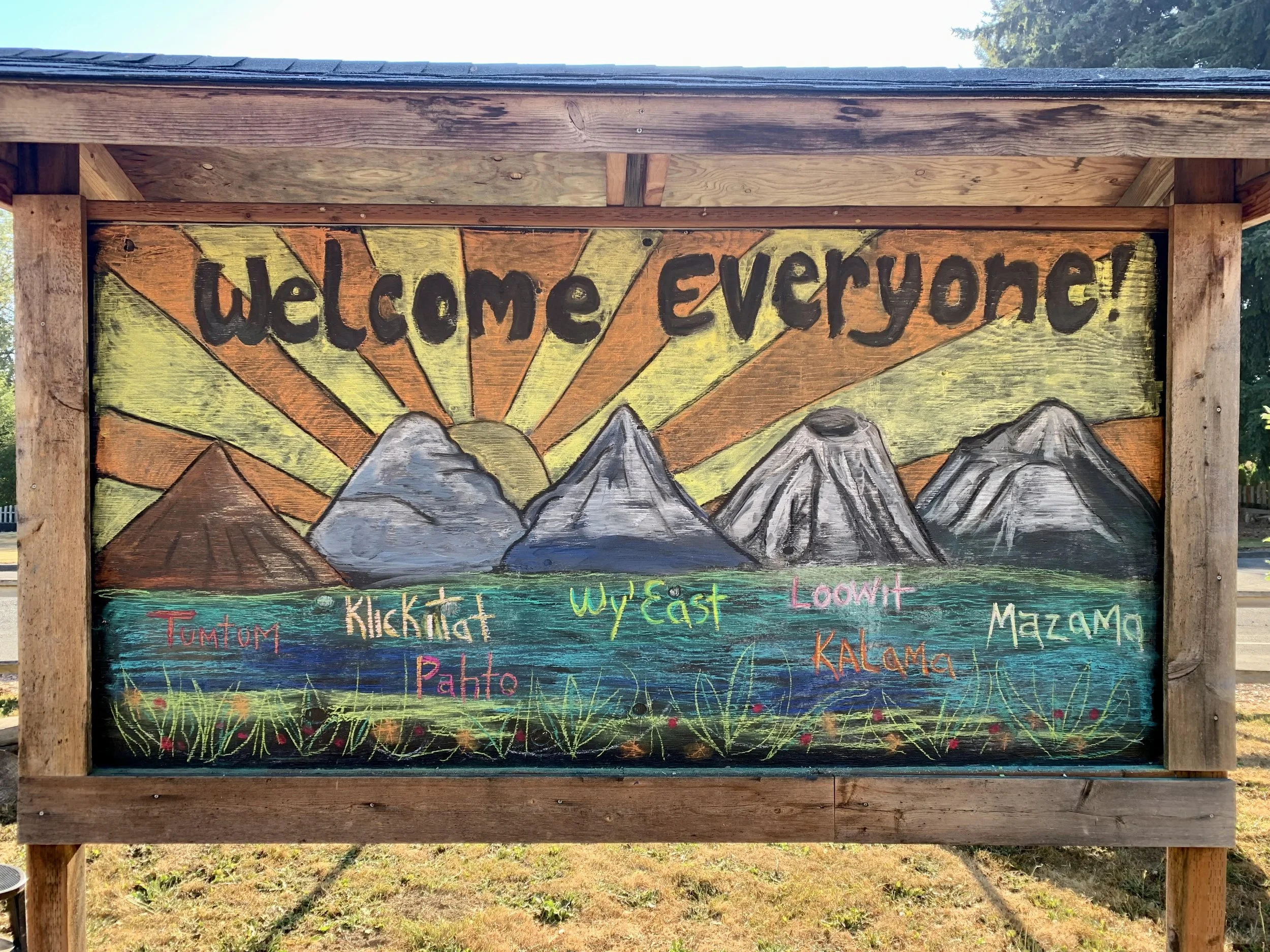
Walk through Gardner School and you'll notice something different about our classrooms. Instead of numbers or colors, each room carries a name rooted in the land beneath our feet and the stories that have been told here for generations.
Our classroom names come from Pacific Northwest volcanic features and the Native American legends that explain them. These names aren't arbitrary. They reflect our commitment to place-based education and our deep respect for the Indigenous peoples who have called this region home for thousands of years.
For children, names matter. When a child says "I'm in Loowit" instead of "I'm in Room 4," they're connecting to something larger than themselves. They're learning that this place has a history, that the mountains on the horizon have stories, and that they are part of an ongoing narrative that stretches back millennia.
Here's the meaning behind each of our classroom names, and why we chose them.
Tumtum (Preschool)
The Name: Tumtum is a late Pleistocene volcanic dome in Washington's Cascade Range, formed approximately 70,000 years ago.
The Meaning: The word "tumtum" means "heart" in Chinook Jargon, the trade language used throughout the Pacific Northwest in the 18th and 19th centuries. Tumtum Mountain served as a significant landmark along trade routes used by the Hudson's Bay Company and Indigenous trading networks long before European contact.
Why We Chose It: Our youngest learners begin their Gardner journey in Tumtum. The name feels right for preschool because it's where the heart of learning begins. These children are just starting to discover who they are as learners, as friends, and as members of a community. Like the volcanic dome that has stood quietly for tens of thousands of years, our preschoolers are building a foundation that will support everything that comes after.
The word itself is gentle and rhythmic, easy for small mouths to say and easy for young minds to remember. And the meaning? We can't think of a better word for a room full of three- and four-year-olds discovering the joy of learning together.
Mazama (Pre-K)
The Name: Mount Mazama was an ancient stratovolcano in the Oregon Cascades. Its catastrophic eruption approximately 7,700 years ago created Crater Lake, one of the deepest and clearest lakes in the world.
The Legend: The Klamath people, who have lived in the Crater Lake region for thousands of years, tell of a great battle between two powerful chiefs. Llao was the chief of the Below World, dwelling beneath the mountain. Skell was the chief of the Above World, residing in the sky. The two chiefs fell into conflict, hurling rocks and flames at one another across the land. Mountains shook. Fire rained from the sky. Finally, Llao was struck down, and the mountain collapsed upon him, creating a massive crater. Over centuries, rain and snowmelt filled the crater, creating the pristine blue lake we see today.
The Klamath people consider Crater Lake a sacred site. For generations, it was a place of vision quests and spiritual significance, so powerful that many tribal members would not look directly at the water.
Why We Chose It: Pre-K is a year of tremendous transformation. Children arrive as preschoolers and leave ready for kindergarten. They're changing in ways that can feel sudden and dramatic, just like the eruption that created Crater Lake. But the Mazama story reminds us that even catastrophic change can create something beautiful. The destruction of the mountain gave birth to one of the most stunning natural features in North America. Our Pre-K students are in their own period of rapid transformation, and we trust that what emerges will be remarkable.
Kalama (Kindergarten)
The Name: The Kalama eruptive period refers to a phase of volcanic activity at Mount St. Helens that began around 1479-1480 CE and continued intermittently for several centuries. It was one of the most significant eruptive periods in the mountain's recent geological history.
The History: Mount St. Helens is among the most active volcanoes in the Cascade Range. Scientists have documented four major eruptive periods over the past 4,000 years, with the Kalama period being particularly significant for its volume of erupted material and the extent of its pyroclastic flows. Native American oral histories from tribes throughout the region vividly describe the volcanic activity of this era: stories of mountains smoking, of ash falling like snow, of the earth itself seeming alive with fire.
The name "Kalama" comes from a Cowlitz word, and the Kalama River (which flows from the slopes of Mount St. Helens to the Columbia River) bears the same name.
Why We Chose It: Kindergarten is a beginning. It’s the start of formal schooling, the first year in the "big kid" part of the building. Our kindergarteners arrive bursting with energy and curiosity, ready to erupt with questions and discoveries. The Kalama period wasn't a single dramatic event but an extended era of activity, building and releasing energy over time. That feels like kindergarten to us: a year of sustained energy, growth, and transformation as children discover what it means to be students.
Pahto (Grade 1)
The Name: Pahto is the Yakama name for Mount Adams, the second-highest peak in Washington State at 12,281 feet. The name translates roughly to "standing high" or "the one who stands out."
The Legend: The Yakama Nation considers Pahto a sacred mountain, a symbol of strength, resilience, and the ability to endure through adversity. One legend tells of a great chief who had two sons. To help them find their places in the world, the father shot two arrows, one to the north and one to the south. He told his sons to follow the arrows and settle where they landed. One son followed his arrow north and became Pahto (Mount Adams). The other followed his arrow south and became Wy'East (Mount Hood). The brothers took their places in the landscape, standing tall and watching over the Columbia River Gorge between them.
Another legend connects Pahto to the story of Loowit, which you'll read about below. In this telling, Pahto was one of two warriors who competed for the love of a beautiful maiden, with tragic consequences for all.
Why We Chose It: First grade is a year of standing taller. Children arrive having just completed kindergarten, and they leave as confident, capable readers and mathematicians. The transformation is remarkable. "Pahto," standing high, captures what we see in our first graders as the year progresses. They're finding their footing, establishing their place in the world of learners, and beginning to stand on their own.
Loowit (Grade 2)
The Name: Loowit is the name that the Cowlitz, Yakama, and other regional tribes used for Mount St. Helens. The name has been translated as "smoking mountain," "fire mountain," or simply "the smoker," a reference to the volcano's frequent activity.
The Legend: The story of Loowit is one of the most beloved legends of the Pacific Northwest, told with variations by many tribes throughout the region.
Long ago, before the mountains existed, there was a beautiful maiden named Loowit. She was so beautiful that two powerful warriors, Pahto and Wy'East, both fell in love with her. The warriors had once been friends, but their rivalry for Loowit's affection turned them into bitter enemies. They fought fiercely, shaking the earth and throwing fire at one another. Their conflict brought destruction to the land and suffering to the people.
The Great Spirit, Tyhee Saghalie, was angered by this destruction. He struck down all three, Loowit, Pahto, and Wy'East, and transformed them into mountains. Pahto became Mount Adams. Wy'East became Mount Hood. And Loowit, the most beautiful of all, became Mount St. Helens.
But even as a mountain, Loowit remembered her beauty. She remained symmetrical and graceful, her slopes gentle and snow-covered, until 1980, when she erupted in one of the most destructive volcanic events in United States history. Some say Loowit is still restless, still remembering the passions that transformed her.
Why We Chose It: Second grade is a year of transformation. The children who enter in September are still "little kids" in many ways, still learning to read fluently, still developing the stamina for longer school days, still figuring out how to navigate friendships and conflicts. By June, they've changed dramatically. They're reading chapter books. They're writing stories with beginnings, middles, and ends. They're managing complex social dynamics.
The legend of Loowit speaks to transformation, to passion, to the consequences of our choices, and to the way beauty can emerge from conflict. These are themes that resonate deeply with second graders, who are navigating their own complex emotional and social landscapes.
Wy'East (Grades 3)
The Name: Wy'East is the name used by the Multnomah and other tribes for Mount Hood, Oregon's highest peak at 11,250 feet. The mountain dominates the Portland skyline and is visible from much of the Columbia River Gorge.
The Legend: As told above, Wy'East was one of the two warriors who competed for Loowit's love. In some versions of the legend, Wy'East was the younger and more impetuous of the two brothers, quick to anger and quick to fight. His transformation into a mountain didn't diminish his proud bearing. Mount Hood stands tall and pointed, as if still straining upward in defiance.
Other legends tell of Wy'East as a guardian figure, watching over the Columbia River and the people who lived along its banks. The mountain's prominence made it a landmark for navigation and a symbol of home for tribes throughout the region.
Why We Chose It: Our third and fourth graders are in what educators sometimes call "the golden years" of elementary school. They've mastered the basics of reading and math, and now they're ready to apply those skills to bigger questions. They're curious, capable, and increasingly confident.
Wy'East, tall, proud, standing at the center of the landscape, captures something essential about this age. These students are beginning to see themselves as capable individuals with their own ideas, their own passions, and their own contributions to make. They're standing taller in their learning.
Tahoma (Grades 4)
The Name: Tahoma is the Indigenous name for Mount Rainier, the tallest peak in the Cascade Range at 14,411 feet and the highest volcanic summit in the contiguous United States. The name comes from Coast Salish languages, including Lushootseed, and is often translated as "mother of waters" or "snow-covered mountain." For generations, people throughout the Puget Sound region have simply called it "The Mountain," a reflection of how completely it dominates the horizon.
The Legend: Tahoma appears in stories told by the Puyallup, Cowlitz, Yakama, Nisqually and other regional tribes, often as one of several mountains whose rivalries and relationships shaped the landscape.
One widely told story describes a great flood that threatened every person and animal in the region. As the waters rose, they climbed to the summit of Tahoma and waited there together until the flood finally receded, safe because the mountain stood taller than the danger below.
Why We Chose It: Fourth grade is when students begin to stand out as leaders among our youngest learners, capable, visible and looked to by others, much like Tahoma itself, which can be seen from nearly every corner of the region. The flood legend reminds us that height and strength aren't really about standing above others.
They're about offering shelter, patience and steadiness during difficult moments, exactly what we see in our fourth graders as they become the steady presence that younger students look up to.
Klickitat (Grades 5 & 6)
The Name: Klickitat refers both to the Klickitat people, an Indigenous nation of the Columbia Plateau, and to Mount Adams (which some sources also call Klickitat). The Klickitat were known as skilled traders and travelers, moving between the Columbia River and the Cascade Range, facilitating exchange between coastal and inland peoples.
The Legend: In some tellings of the Loowit legend, the warrior who became Mount Adams is called Klickitat rather than Pahto. According to these versions, Klickitat was the older and wiser of the two brothers, more patient and more sorrowful when he realized what their conflict had cost them all.
The most poignant detail: some say that Mount Adams bends slightly toward Mount St. Helens, as if Klickitat is still gazing at Loowit in sorrow, still mourning the love that destroyed them both.
Why We Chose It: Fifth and sixth grade is a time of deepening. Our oldest elementary students are developing the capacity for abstract thinking, for empathy, for understanding multiple perspectives on complex issues. They're beginning to grapple with questions that don't have easy answers.
The image of Klickitat bending toward Loowit in sorrow speaks to something important about this developmental stage. These students are learning what it means to care deeply about friends, about causes, about the world. They're discovering that caring can be painful, that wisdom often comes with a cost, and that the most meaningful relationships require us to bend toward one another.
Why Place-Based Names Matter
At Gardner, we believe that education should be rooted in place. Our five-acre campus isn't just a convenient location, it's an integral part of our curriculum. Children learn in the garden, explore the woods, observe seasonal changes in the plants and animals around them.
Our classroom names extend this philosophy. When children learn that their classroom is named after a volcano visible from our campus, or after a legend told by the Indigenous peoples who have lived here for millennia, they begin to understand that they are part of a larger story. The Pacific Northwest isn't just scenery. It's a living landscape with its own history, its own stories, and its own lessons to teach.
Every time a child says "I'm in Mazama" or "Let's go to Pahto," they're participating in that larger story. They're honoring the Indigenous peoples who named these places and told these stories. They're connecting to the geological forces that shaped this land. And they're learning that the places where we live and learn have meaning.
A Note on Indigenous Stories
We share these legends with deep respect for the Indigenous peoples who have told them for generations. These are not our stories to own. They are gifts that have been shared with us, and we try to honor them by sharing them accurately and respectfully with our students.
We encourage families to learn more about the Indigenous nations of the Pacific Northwest, including the Cowlitz, Yakama, Klickitat, Multnomah, Chinook, and Klamath peoples whose traditional territories include the places we've named in this guide. Many of these nations have active cultural programs, museums, and educational resources available to the public.
Conclusion
Names matter. The names we give to spaces shape how we think about them, how we feel in them, and what we believe is possible within them.
At Gardner, our classroom names invite children into a relationship with this place: the mountains on the horizon, the volcanic soil beneath their feet, the stories that have been told here for thousands of years. When a child walks into Loowit or Tumtum or Klickitat, they're entering a story.
And in the best educational settings, that's exactly what learning is: entering a story that's bigger than ourselves, and discovering our own place within it.